Content anchor
Low-resolution input
Preserves scene identity and low-frequency structure. A local CNN path catches semantic drift and structural errors.
Dual-Reference SR-IQA with Generated Image Guidance as Perceptual Anchors
A new quality metric that asks two different questions: does the super-resolved image preserve the original content—and does it look perceptually natural?
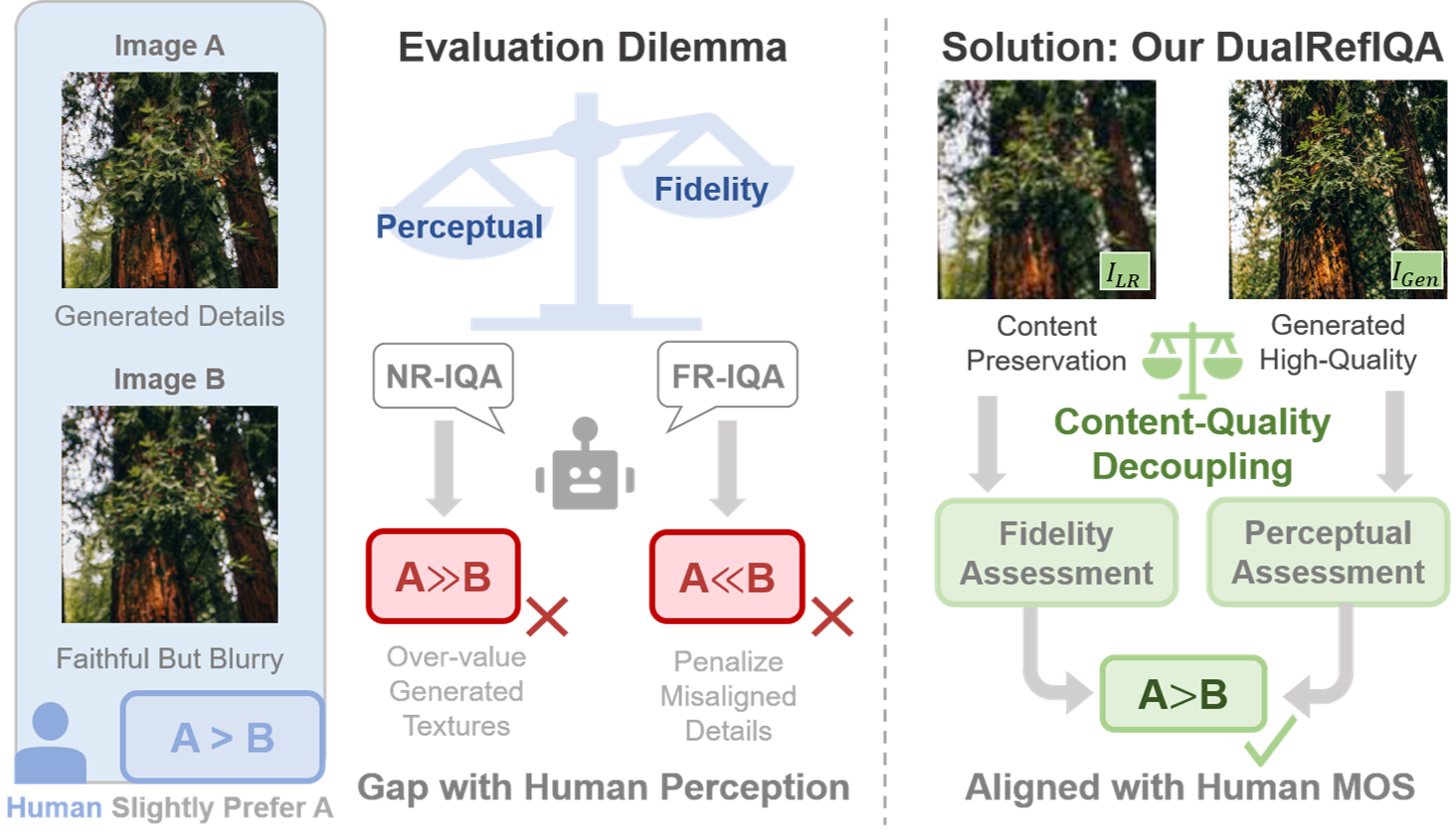
The evaluation dilemma
Full-reference metrics require unavailable ground-truth HR images and over-penalize plausible, misaligned details.
No-reference metrics can reward sharp-looking hallucinations because they lack a content anchor.
The idea
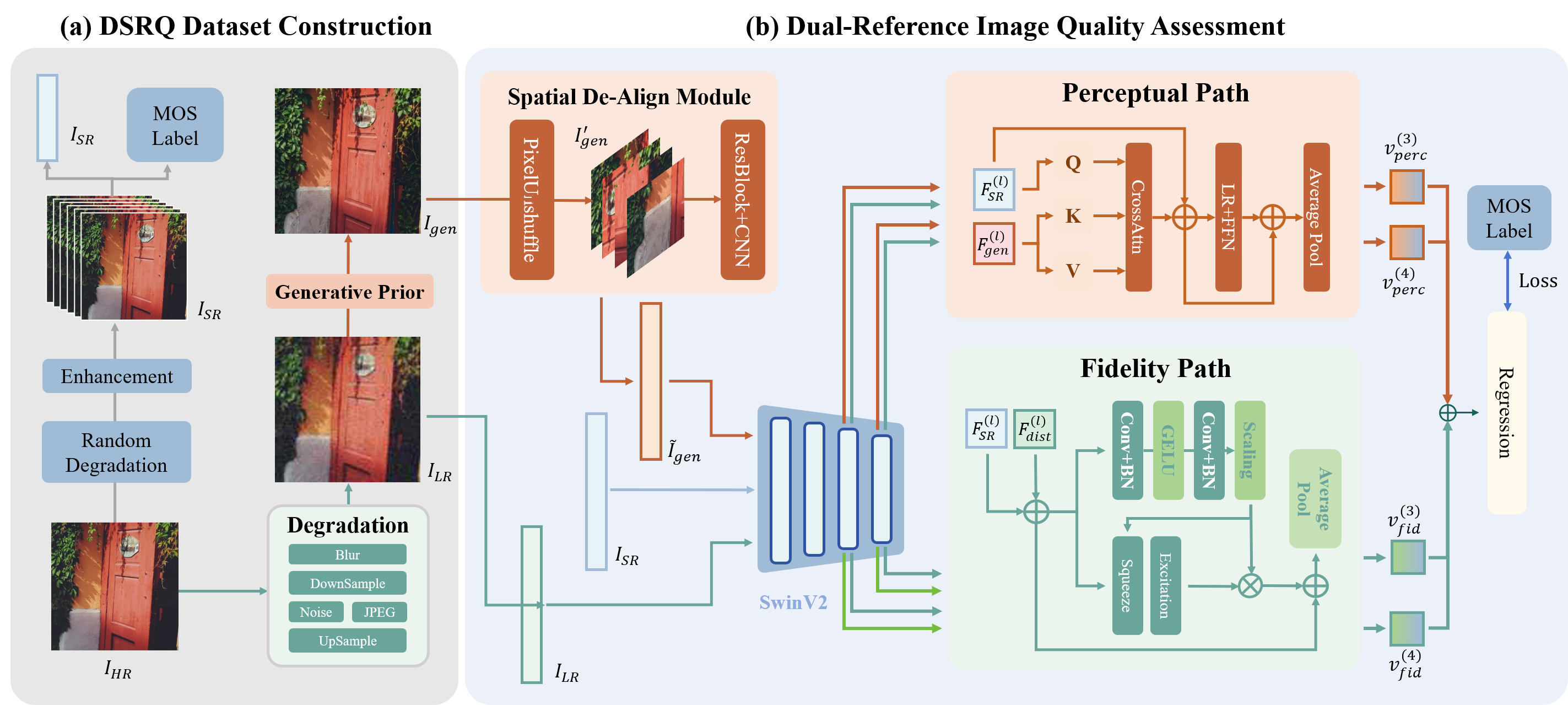
DualRefIQA explicitly separates content correctness from visual quality, using the right reference—and the right matching strategy—for each.
Content anchor
Preserves scene identity and low-frequency structure. A local CNN path catches semantic drift and structural errors.
Perceptual anchor
Provides rich texture statistics. Cross-attention evaluates naturalness without requiring pixel-level alignment.
Experimental results
DualRefIQA delivers leading correlation among methods that do not use inaccessible ground-truth HR references.
DSRQ · SRCC
0.6913best non-GT resultDSRQ · PLCC
0.6922human score alignmentISRGen-QA · SRCC
0.7773strong cross-dataset fitISRGen-QA · PLCC
0.8324without GT HR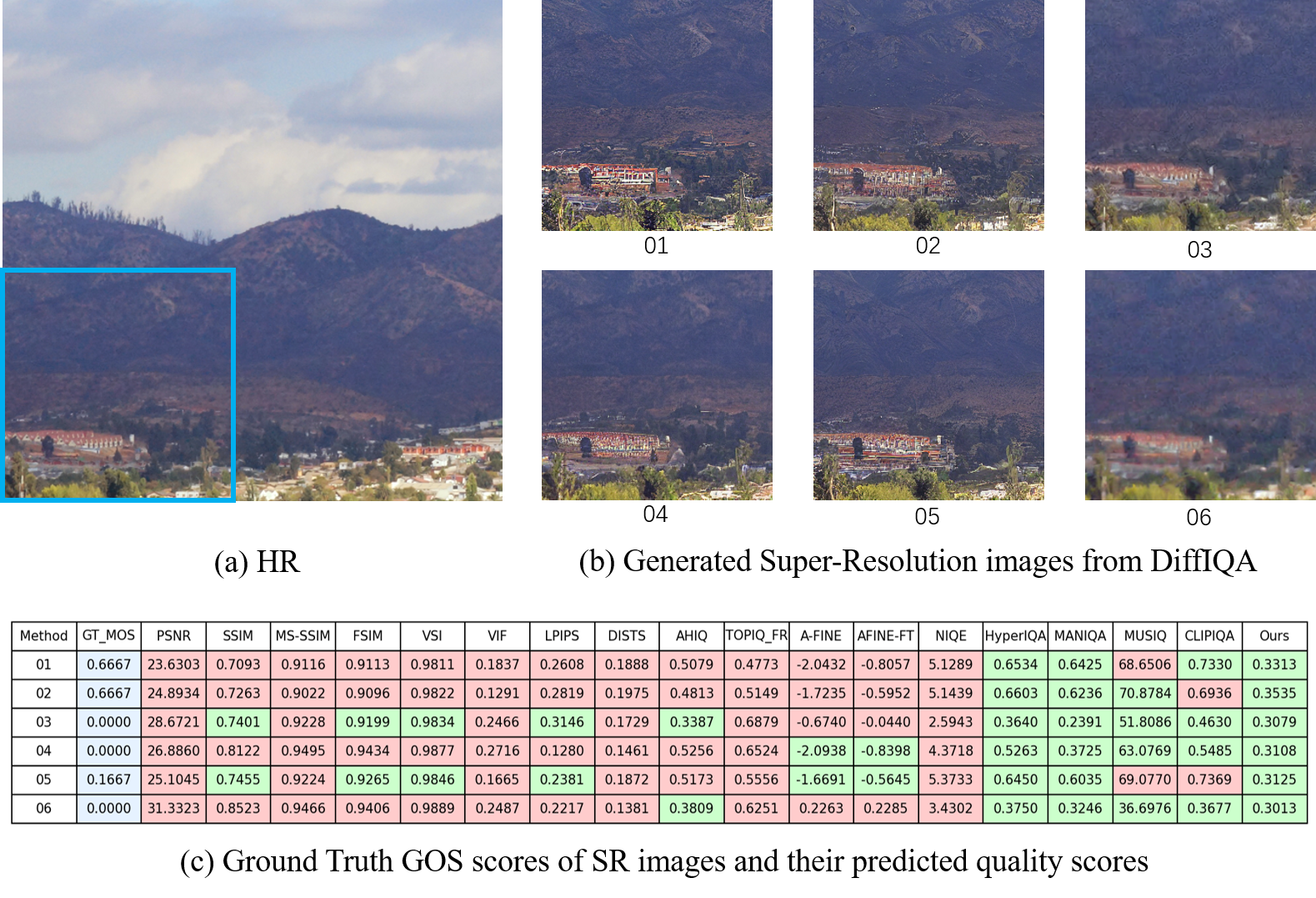
Qualitative comparison
Conventional metrics often give high scores to generated detail even when it changes scene structure. By consulting both anchors, DualRefIQA better reproduces the ordering chosen by human raters.
Beyond evaluation
Used as a training objective, DualRefIQA guides SR models toward sharper, more natural textures while retaining structural fidelity. On RCAN, adding the metric improves PSNR, SSIM, LPIPS, and the predicted perceptual quality score over the corresponding baseline.
Citation
The submission PDF is anonymized; this provisional entry can be updated with the final author list and publication identifiers.
@inproceedings{xu2026dualrefiqa,
  title     = {Bridging the Reference Gap: Dual-Reference SR-IQA
               with Generated Image Guidance as Perceptual Anchors},
  author    = {Xu, Shenghan and others},
  booktitle = {Proceedings of the 34th ACM International Conference
               on Multimedia},
  year      = {2026}
}